
Introduction
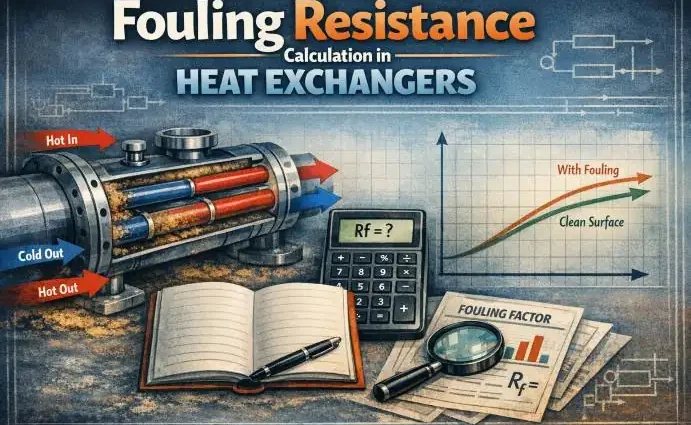
The fouling resistance calculation is a critical part of heat exchanger design and performance evaluation. In real industrial systems, heat exchangers rarely operate under clean conditions. Over time, deposits such as scale, corrosion products, biofouling, or dirt accumulate on heat transfer surfaces, reducing efficiency.
A proper fouling resistance calculation allows engineers to account for this degradation during design, ensuring that the heat exchanger continues to meet its duty even after prolonged operation.
Ignoring fouling can lead to undersized equipment, reduced heat transfer performance, increased pressure drop, and higher operating costs. Therefore, understanding how to perform a fouling resistance calculation is essential for reliable and safe design.
What is Fouling Resistance?
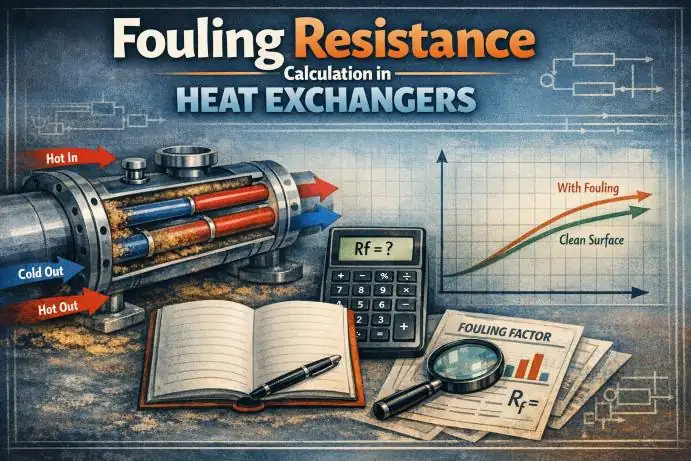
Fouling resistance represents the additional thermal resistance caused by deposits on heat transfer surfaces.
It is typically denoted as:
Where:
- = fouling resistance (m²·K/W)
- = fouled overall heat transfer coefficient
- = clean overall heat transfer coefficient
This expression is the foundation of any fouling resistance calculation.
Physical Meaning
The fouling resistance calculation quantifies how much extra resistance is added due to fouling layers.
In practical terms:
- Clean exchanger → high heat transfer
- Fouled exchanger → reduced heat transfer
Thus:
Fouling Resistance in Design
In design practice, fouling is included directly in the overall heat transfer coefficient:
Where:
- , are fouling resistances on hot and cold sides
This is the most commonly used fouling resistance calculation approach in heat exchanger sizing.
Step-by-Step Fouling Resistance Calculation
Step 1: Determine Clean Heat Transfer Coefficient
Calculate using standard correlations:
- Convective coefficients (Dittus-Boelter, Kern, etc.)
- Wall resistance
Step 2: Obtain Fouled Heat Transfer Coefficient
This may come from:
- Measured plant data
- Design requirement
- Estimated degradation
Step 3: Apply Fouling Resistance Formula
Step 4: Example Calculation
Assume:
- Uc=800W/m2K
- Uf=600W/m2K
Then:
This value represents the total fouling resistance.
Fouling Factors from Standards
Instead of calculating from scratch, engineers often use tabulated values.
Typical sources:
- TEMA (Tubular Exchanger Manufacturers Association)
- API standards
Example values:
| Fluid | Fouling Resistance (m²·K/W) |
|---|---|
| Cooling water | 0.0002 |
| Sea water | 0.0005 |
| Fuel oil | 0.0009 |
These values are used directly in fouling resistance calculation during design.
Overdesign and Fouling
Fouling resistance directly influences overdesign:
This ensures the exchanger meets duty even when fouled.
Practical Engineering Considerations
When performing a fouling resistance calculation, consider:
- Nature of fluid (dirty vs clean service)
- Operating temperature
- Velocity (higher velocity reduces fouling)
- Maintenance schedule
Common Mistakes
- Ignoring fouling completely
- Using unrealistic fouling factors
- Not updating fouling values with plant data
- Double counting fouling
References
- Kern, D.Q. – Process Heat Transfer
- Incropera & DeWitt – Fundamentals of Heat Transfer
- TEMA Standards
- Coulson & Richardson – Chemical Engineering Vol. 6
Conclusion
The fouling resistance calculation is essential for designing reliable heat exchangers. By properly accounting for fouling, engineers ensure long-term performance and avoid costly operational issues.
External resources
Fouling – wikipedia article


