

When working in engineering, one of the most common yet overlooked challenges is unit conversion. The distinction between SI units vs US units can significantly impact the accuracy and clarity of your engineering calculations. Whether you’re designing a heat exchanger, running process simulations, or calculating fluid dynamics, using the wrong unit system can lead to serious design flaws.
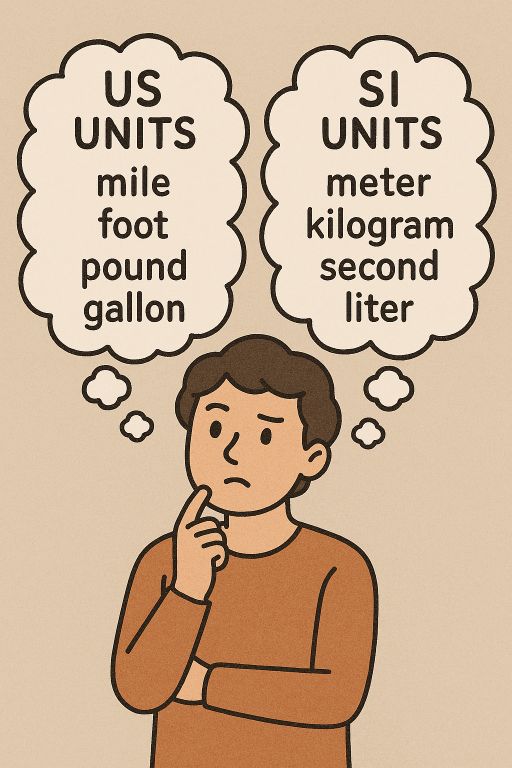
This article explores the differences between SI units and US customary units, how to convert between them, and the implications for engineers working across international standards.
What Are SI Units?
The International System of Units (SI) is the most widely used measurement system globally. It is a modern version of the metric system and is officially adopted by almost every country in the world except the United States, Liberia, and Myanmar.
Common SI units used in engineering include:
- Length: meter (m)
- Mass: kilogram (kg)
- Temperature: Kelvin (K) or Celsius (°C)
- Time: second (s)
- Force: newton (N)
- Pressure: pascal (Pa)
- Energy: joule (J)
- Power: watt (W)
- Volume: Liter (L), (m³)
What Are US Customary Units?
The US customary system is derived from British imperial units. Although it uses some of the same base units, it varies significantly in magnitude and is less standardized.
Common US units in engineering include:
- Length: inch (in), foot (ft)
- Mass: pound-mass (lbm)
- Temperature: Fahrenheit (°F)
- Force: pound-force (lbf)
- Pressure: pounds per square inch (psi)
- Energy: British thermal unit (BTU)
- Power: horsepower (hp)
- Volume: Gallon (gal), ft³
SI Units vs US Units: Key Differences
| Property | SI Units | US Units |
|---|---|---|
| Temperature | Celsius / Kelvin | Fahrenheit |
| Pressure | Pascal (Pa), bar | psi |
| Energy | Joule (J) | BTU |
| Length | Meter, millimeter | Inch, foot |
| Volume | Liter (L), m³ | Gallon (gal), ft³ |
| Mass | Kilogram | Pound-mass (lbm) |
| Force | Newton | Pound-force (lbf) |
| Flow Rate | m³/s, L/s | ft³/min, gal/min (GPM) |
| Power | Watt | Horsepower (hp) |
Why It Matters: Misunderstanding SI units vs US units has led to project failures, including the famous NASA Mars Climate Orbiter mishap, which was lost due to a mix-up between pound-force seconds and newton-seconds.
How to Convert Between SI Units and US Units
To avoid mistakes, you need accurate conversion factors. Some key examples:
| Convert From | To | Multiply By |
|---|---|---|
| inch | meter | 0.0254 |
| foot | meter | 0.3048 |
| pound (lbm) | kilogram | 0.45359237 |
| psi | pascal | 6894.76 |
| BTU | joule | 1055.06 |
| horsepower | watt | 745.7 |
| Fahrenheit (°F) | Celsius (°C) | (F – 32) x 5/9 |
| gallon (US) | liter | 3.78541 |
| cubic foot | cubic meter | 0.0283168 |
You can also use unit conversion tools like:
- Webbusterz Engineering software – units converter
- NIST.gov conversion tables
- CoolProp libraries
Best Practices for Engineers Working with Mixed Units
- Always label units clearly in documentation, code, and designs.
- Use dimensional analysis to verify unit consistency.
- Avoid mixing systems within the same equation or dataset.
- Automate conversions in software tools to prevent human error.
- Default to SI units when collaborating internationally.
- Use software that supports both systems
Example: Heat Transfer Calculation in Both Systems
Below are two calculations looking at SI units vs US units;
Using SI Units:
Q = m × Cp × ΔT
Q = 1.2 kg/s × 4186 J/kg·K × (60 - 20)K
Q = 200,928 W or 200.9 kW
Using US Units:
Q = m × Cp × ΔT
Q = 2.65 lb/s × 1 BTU/lbm·°F × (140 - 100)°F
Q = 106 BTU/s ≈ 112 kW
Even though the two calculations are equivalent, rounding and conversion errors may cause mismatches. This is why understanding SI units vs US units is crucial.
Why Engineers Should Standardize on SI Units
- Universally adopted in scientific and academic contexts
- Reduces confusion and lowers risk of errors
- More precise definitions and easier scalability
- Integrated into most software platforms
However, some industries (e.g., HVAC, oil & gas in the US) still rely heavily on US units, so familiarity with both systems is essential.
In Summary
Understanding the difference between SI units vs US units is essential for any practicing engineer. From design specs to simulations and international collaboration, using the correct units can make or break your project.
Take the time to familiarize yourself with both systems, use accurate conversions, and always double-check your work. Precision in units equals precision in engineering. Hopefully this article did explain the difference between SI units vs US units


